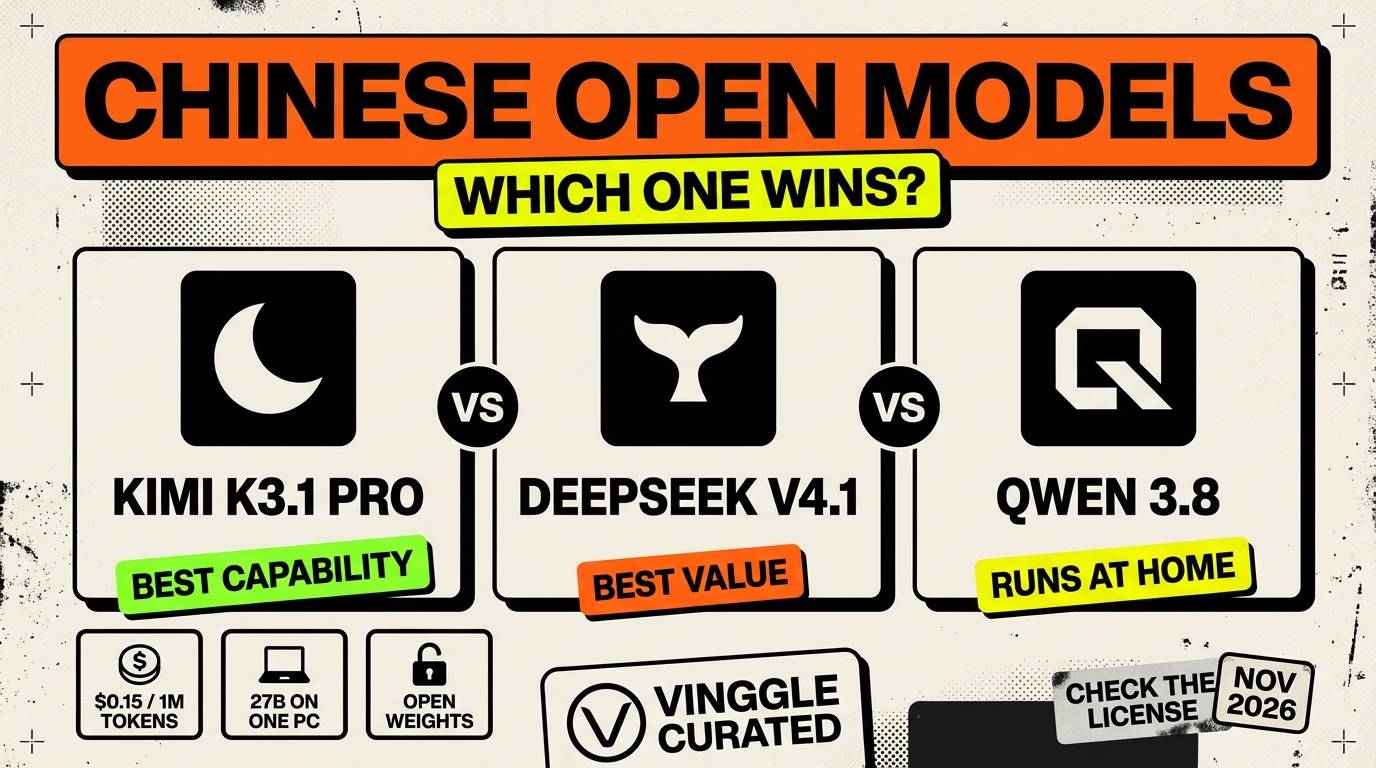
The short answer: there is no single winner, because each of the three leads at something different. Kimi K3.1 Pro is the most capable of the three on hard coding and agent work, DeepSeek V4.1 Flash is far cheaper and much faster, and the Qwen3.8 family is the only one with a model you can realistically run on a single machine. All three publish open weights, but the licenses are not the same.
Key Takeaways
- Kimi K3.1 Pro leads the open-weight field on Artificial Analysis's index and on Terminal-Bench 4.0, at $2 / $10 per million tokens.
- DeepSeek V4.1 Flash costs $0.15 / $0.60 off-peak, uses an MIT license, and in one comparison costs about six times less per task than Kimi.
- Qwen3.8-27B is the practical choice for running a model yourself, with an Apache 2.0 license, though it is much weaker than the flagships on hard coding.
- Kimi K3.1 Pro's open weights went live on November 2, 2026, so articles saying they are only "promised" are out of date.
- "Open weights" is not the same as open source. Read each license before commercial use.
Last updated: November 2026. Model versions, aliases and prices change often, so confirm current figures on each provider's page.
How we compared: this guide draws on provider pricing and model pages, plus several independent comparisons published in October and November 2026, including Morph, Toloka and Regolo. We did not run our own benchmarks. Scores depend on the test and the effort setting used, and different trackers disagree, so we show the direction of each result and mark whose numbers they are.
In This Article
- Quick verdict
- Meet the three families
- Specs side by side
- Coding and agent work
- Overall quality
- Cost and speed
- Running them yourself
- Licenses and risks
- Who should use what
- How to test them in 15 minutes
- FAQ
Quick Verdict
- Best capability: Kimi K3.1 Pro.
- Best value and speed: DeepSeek V4.1 Flash.
- Best to run on your own hardware: Qwen3.8-27B.
- Most permissive license: DeepSeek (MIT), then Qwen3.8-27B (Apache 2.0).
- Most conditions on commercial use: Kimi K3.1 Pro, which has two large-scale conditions.
Meet the Three Families
Kimi K3.1 Pro (Moonshot AI)
Moonshot launched the K3.1 Pro API on October 23, 2026 and published the open weights on Hugging Face on November 2, ungated. It is a mixture-of-experts model with about 2.8 trillion total parameters, 104 billion active at a time, a 1-million-token context window and image input. The API costs a third less than the earlier Kimi K3. Moonshot says it removed cyber-related training data from the open release.
DeepSeek V4.1 Flash (DeepSeek)
The V4.1 Flash model was announced on September 10, and the "1017" update followed on October 17. It has about 552 billion parameters in a mixture-of-experts design (some counts of the published files show closer to 763 billion), a 1-million-token context window and image input, under an MIT license. DeepSeek's hosted deepseek-flash name now points to the October checkpoint, and the older V4 Pro model remains available as a text-only option.
Qwen3.8 (Alibaba)
Qwen is a family rather than one model. The flagship has about 2.4 trillion parameters with 95 billion active, a hosted Max API at roughly $2 / $6 per million tokens, and open weights under a custom Qwen license. The standout for most people is Qwen3.8-27B, a 27-billion-parameter dense model under Apache 2.0, with a native 262,144-token context that can be extended to 1 million.
Specs Side by Side
| Kimi K3.1 Pro | DeepSeek V4.1 Flash | Qwen3.8 flagship | Qwen3.8-27B | |
|---|---|---|---|---|
| Size | 2.8T total, 104B active | About 552B total | 2.4T total, 95B active | 27B dense |
| Context | 1M tokens | 1M (384K output) | About 1M (131K output) | 262K native, up to 1M |
| Open weights | Yes, since Nov 2 | Yes | Yes | Yes |
| License | Kimi K3.1 Pro License | MIT | Qwen3.8-Max License | Apache 2.0 |
| API price per 1M tokens | $2 in, $0.20 cached, $10 out | $0.15 in, $0.60 out (off-peak) | About $2 in, $6 out | Self-host |
Coding and Agent Work
As usual, the models trade wins depending on the test. These results come from Regolo's comparison and are reported by third parties, with Claude Opus 5.5 shown only as a reference point:
| Benchmark | Kimi K3.1 Pro | DeepSeek V4.1 Flash | Qwen3.8-27B | Opus 5.5 (reference) |
|---|---|---|---|---|
| Terminal-Bench 4.0 | 65.7% | 42.3% | Not reported | 66.4% |
| DeepSWE v1.1 | 75.5% | 77.0% | 42.5% | 74.2% |
| OfficeQA Pro v2 (scanned documents) | 64.4% | 40.4% | Not reported | Not reported |
Kimi pulls clearly ahead on terminal-based agent work and scanned-document questions, while DeepSeek edges it on multi-turn repository bug fixing. Qwen3.8-27B is far behind on hard coding, which is the price of a model small enough to run at home. LiveBench 2.0's October 25 release put DeepSeek V4.1 Flash at 74.0 overall and Kimi K3.1 Pro at 71.3, so the ranking also depends on the benchmark you pick.
Coding verdict: Kimi for terminal and agent workflows, DeepSeek for repository fixes at low cost, and Qwen3.8-27B only when running locally matters more than raw strength. For the closed frontier models, see our guide to Gemini 4 Argon vs GPT-6 vs Claude Opus 5.5.
Overall Quality
On Artificial Analysis's index, as summarized in Regolo's comparison, Kimi K3.1 Pro scores 46 and is the top open-weight model, against 59 for Claude Opus 5.5. DeepSeek V4.1 Flash and Qwen3.8-27B score lower in the same snapshot, although scores shift with the effort setting and index version, and another tracker puts DeepSeek's maximum-effort run closer to Kimi. The consistent message is that the best open models still trail the best closed ones, but the gap is smaller than the price difference suggests.
Cost and Speed
| Model | Price per 1M tokens (in / out) | Cost per average task (Regolo) | Speed (Regolo) |
|---|---|---|---|
| DeepSeek V4.1 Flash | $0.15 / $0.60 off-peak, $0.30 / $1.20 peak | About $0.60 | About 174 tokens per second |
| Kimi K3.1 Pro | $2 / $10 | About $3.68 | About 33 tokens per second |
| Claude Opus 5.5 (reference) | $4 / $20 | About $10.04 | Not reported |
DeepSeek is about six times cheaper per task than Kimi and streams more than five times faster, which matters for chat and agent loops where waiting adds up. Its peak price is double the off-peak rate, so scheduling batch work off-peak can halve your bill. Kimi charges the same rate at any context length.
Running Them Yourself
| Model | Realistic hardware |
|---|---|
| Kimi K3.1 Pro | Cluster scale, because of its 2.8 trillion parameters |
| DeepSeek V4.1 Flash | A large multi-GPU server |
| Qwen3.8 flagship | Cluster scale |
| Qwen3.8-27B | A single machine, which is its main selling point |
For nearly everyone, "open weights" means being able to pay a hosting provider you choose, not running the flagships at home. Qwen3.8-27B is the exception, and our guide to the best free local AI tools covers how to run models like it.
Licenses and Risks
- DeepSeek (MIT): the most permissive, with no revenue or user conditions.
- Qwen3.8-27B (Apache 2.0): permissive. The larger flagship uses a custom Qwen license, so check its model card.
- Kimi K3.1 Pro: an MIT-style license with two conditions, reportedly starting at $20 million in revenue or 100 million monthly users. Small teams are unaffected, but large companies need to read it.
- Floating names change under you. DeepSeek's hosted alias now points to the October checkpoint. Pin an exact version if your results must stay stable.
- Hosted APIs process your data. If you use any provider's own API, read its data terms. Self-hosting removes the question.
Who Should Use What
- Teams building agents for terminal and document work: Kimi K3.1 Pro.
- High-volume apps where cost and speed rule: DeepSeek V4.1 Flash.
- Anyone who wants to self-host on a single machine: Qwen3.8-27B.
- Companies with strict license rules: DeepSeek for MIT, or Qwen3.8-27B for Apache 2.0.
- Developers who want to swap models later: any of them, behind a thin wrapper so the model name is a setting.
How to Test Them in 15 Minutes
- Pick three tasks from your own work: a bug fix, a long document summary and an agent-style task.
- Run the same prompt through each model's API or a host that offers all three.
- Measure follow-up edits, time and cost per task, not just how good the first answer looks.
- Repeat at off-peak and peak hours if you use DeepSeek, since pricing differs.
- Re-test after a month, because versions and aliases change quickly.
Frequently Asked Questions
Which Chinese open model is best in 2026?
Kimi K3.1 Pro for capability, DeepSeek V4.1 Flash for price and speed, and Qwen3.8-27B for running on your own hardware.
Is Kimi K3.1 Pro open source?
Its weights are open, published on Hugging Face on November 2, 2026, under the Kimi K3.1 Pro License. That is an MIT-style license with conditions that reportedly start at $20 million in revenue or 100 million monthly users, so it is open weights rather than plain open source.
Which is the cheapest to use?
DeepSeek V4.1 Flash, at $0.15 / $0.60 per million tokens off-peak.
Can I run these models at home?
Only Qwen3.8-27B realistically. Kimi, DeepSeek and the Qwen flagship need cluster or multi-GPU servers.
Are they as good as GPT-6 or Claude Opus 5.5?
Not quite. Kimi K3.1 Pro is the closest, but the best closed models still lead on independent indexes. The gap is small relative to the price difference.
Sources: Morph's Kimi K3.1 Pro analysis, Toloka's guide to Chinese AI models and Regolo's benchmark comparison, all from October and November 2026. More coding tools are listed in Vinggle's AI Code Tools directory. If you build one, submit it to Vinggle.